If you sell clothing, footwear, or home textiles into the EU, you are about to start paying for what happens to those products after your customers throw them away. EU textile EPR (Extended Producer Responsibility) under the revised Waste Framework Directive (Directive (EU) 2025/1892) requires every member state to set up mandatory EPR schemes for textiles by roughly April 2028. That means fees for collection, sorting, reuse, and recycling land on your balance sheet.
Most brands know this is coming. What fewer have figured out: the size of that fee depends on how sustainable your product actually is. And the data that proves it? The same data in your Digital Product Passport. This makes textile EPR the second major EU compliance driver alongside the ESPR, and the first one with a direct financial upside for getting your product data right.
What Is Textile EPR?
Right now, when your customers throw away a shirt, the municipality picks up the tab for collection and disposal. EPR flips that. Brands pay fees into a collective scheme that handles end-of-life management — collection, sorting, recycling.
EPR itself isn't new. Packaging, electronics (WEEE), and batteries have had it for years. Textiles at the EU level, though — that's new. Until now, only France had a mandatory textile EPR scheme: Refashion (formerly Eco-TLC), running since 2007, processing over 700,000 tonnes of textiles annually.
The revised Waste Framework Directive takes France's model and rolls it out across all 27 member states.
What the Fees Cover
Textile EPR fees fund the entire post-consumer chain:
- Collection — setting up and operating textile collection points
- Sorting — separating items for reuse, recycling, or disposal
- Recycling — processing textiles into new fibers or materials
- Reuse preparation — cleaning and repairing items for second-hand markets
- Awareness campaigns — informing consumers about textile collection options
The fee per unit varies by product type, weight, and — critically — the product's environmental design characteristics.
Who Does Textile EPR Apply To?
The directive covers every producer who makes textiles available on the EU market. "Producer" in EPR terms means whoever first places the product on the market — whether you manufacture it, import it, or sell it under your own brand.
Products Covered
- Clothing (all categories)
- Footwear
- Accessories (bags, belts, scarves, hats)
- Household textiles (bed linen, blankets, towels, curtains)
- Carpets and floor coverings
Who Counts as a Producer?
| Scenario | Are You the Producer? |
|---|---|
| EU-based brand selling own-label products | Yes |
| Non-EU brand selling via own e-commerce into the EU | Yes |
| Non-EU brand selling via EU marketplace (Amazon, Zalando) | Yes — but marketplace may handle registration |
| EU retailer selling third-party brands | No — the brand owner is the producer |
| EU importer of non-EU brands | Yes — the importer becomes the producer |
If you are based outside the EU but sell textiles to EU customers — whether through your own website, Amazon, or any other channel — you are subject to textile EPR obligations. You must either register with an EPR scheme in each member state where you sell, or appoint an authorized representative to do so. This mirrors the approach already used for packaging EPR and WEEE.
Micro-Enterprise Grace Period
Micro-enterprises (fewer than 10 employees, under 2 million EUR annual turnover) get an extra 12 months — roughly April 2029 in most member states. But it's a grace period, not an exemption. The obligations still apply.
What Is the Timeline?
The clock started October 16, 2025, when the revised Waste Framework Directive entered into force. Member states have 30 months from that date to transpose the directive and stand up their textile EPR schemes.
| Milestone | Estimated Date | What Happens |
|---|---|---|
| Directive enters into force | October 16, 2025 | Clock starts for member states |
| Member state transposition deadline | ~April 2028 | National EPR schemes must be operational |
| Micro-enterprise obligations begin | ~April 2029 | 12-month grace period expires |
| First eco-modulation criteria applied | 2028–2029 | Fees differentiated by product sustainability |
| Full scheme maturity | 2030+ | Collection targets, recycling quotas enforced |
France's Refashion scheme has been operating since 2007. The Netherlands introduced a voluntary textile collection system in 2023. Germany's Federal Ministry for the Environment (BMUV) published a full textile EPR policy paper on March 27, 2026 — proposing 70% collection, 95% recovery, and 85% recycling targets, eco-modulated fees tied to durability, repairability, and recyclability, and a June 17, 2027 national transposition target. Italy and Spain are both in the legislative drafting stage. The 30-month EU deadline is the maximum — some member states are clearly moving faster.
Refashion is only one of several French textile rules. France also bans PFAS in clothing and footwear and runs the coût environnemental environmental-cost label (check if you're in scope), all of which apply to anyone selling into France. See our guide to selling textiles into France for the full picture.
How this sits alongside the ESPR
Two regulations, different angles on the same product:
- ESPR governs product design and information — what your product must be, what data goes into your DPP
- WFD textile EPR governs end-of-life responsibility — who pays for collection and recycling, and how much
The overlap is in the data. The sustainability characteristics ESPR requires you to document in a DPP are the same ones that determine your eco-modulated EPR fees. The European Commission designed it that way deliberately.
Eco-Modulation: Where Your DPP Meets Your EPR Bill
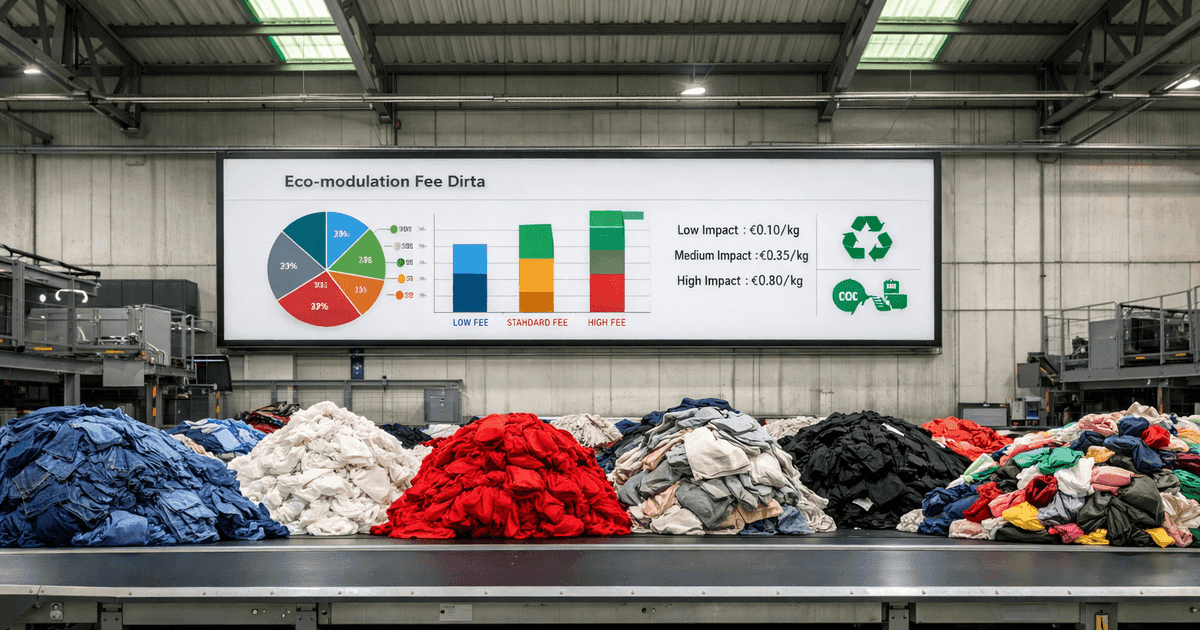
Eco-modulation adjusts your EPR fee based on how your product is designed. A durable, recyclable product made with recycled materials pays less. A product that's hard to recycle, contains hazardous substances, or falls apart after ten washes pays more.
This is where textile EPR connects directly to your DPP data strategy. The data that drives eco-modulation discounts is largely the same data you need for your Digital Product Passport.
What Data Drives Eco-Modulation Fees?
Based on France's Refashion scheme (the most mature reference) and the directive's eco-modulation criteria, the following product characteristics influence your fee:
| Data Point | EPR Fee Impact | Also Required for DPP? |
|---|---|---|
| Material composition | Base fee calculation | Yes — Tier 1 (near-certain) |
| Recycled content (%) | Fee reduction | Yes — Tier 1 (near-certain) |
| Mono-material percentage | Fee reduction (easier recycling) | Yes — Tier 2 (expected) |
| Durability (expected lifetime) | Fee reduction | Yes — Tier 2 (expected) |
| Repairability features | Fee reduction | Yes — Tier 2 (expected) |
| Recyclability grade | Fee reduction | Yes — Tier 1 (near-certain) |
| Presence of hazardous substances | Fee increase | Yes — Tier 1 (near-certain) |
| Microfiber shedding potential | Fee increase | Possible — Tier 3 |
Six of the eight eco-modulation criteria already overlap with expected DPP data requirements.
A Concrete Example
Consider two cotton t-shirts from the same brand:
T-shirt A — 100% conventional cotton, blended fiber stitching, plastic-coated print, expected lifetime of 30 washes.
T-shirt B — 70% organic cotton / 30% recycled cotton, mono-material construction (cotton-only stitching), water-based print, expected lifetime of 50+ washes, designed for fiber-to-fiber recycling.
Under eco-modulation, T-shirt B qualifies for fee reductions on four criteria: recycled content (30%), mono-material design, higher durability, and a recyclability grade of A. In France's current Refashion scheme, eco-modulated bonuses can cut the base fee by up to 50%. Across thousands of units per season, that adds up.
The data that proves T-shirt B deserves those reductions? Same data as its Digital Product Passport.
What Does This Mean for Your DPP Penalties Exposure?
Textile EPR creates a second enforcement path beyond ESPR. Even if ESPR delegated acts for textiles slip (and the DPP timeline suggests they might), EPR schemes will be running by 2028 and will need product data for fee calculation. If you can't provide sustainability data, you default to the highest fee tier.
That's not a theoretical compliance risk. It's a line item on your EPR invoice.
What Should Brands Do Now?
You don't need to wait for your member state to publish its EPR scheme. The data requirements will look similar everywhere because the directive sets minimum eco-modulation criteria that all national schemes must implement.
Priority Actions
-
Audit your material composition data. Can you document the exact fiber content, blend ratios, and material weight for every product? This is the foundation for both DPP compliance and EPR fee calculation.
-
Track recycled content with evidence. Eco-modulation discounts for recycled content require proof — typically a certification or supplier declaration. Start requiring this documentation from your supply chain now.
-
Assess recyclability. Can your products be recycled through existing fiber-to-fiber processes? Mono-material products score higher. Products with mixed materials, coatings, or non-removable trims score lower.
-
Build your DPP. A Digital Product Passport for fashion brands is no longer just an ESPR compliance requirement — it is the data infrastructure that powers your eco-modulation fee reductions. The sooner you start collecting and structuring this data, the lower your EPR costs will be when schemes launch.
-
Register for EPR schemes proactively. If you sell into France, register with Refashion now. For other markets, monitor your member state's transposition progress and register as soon as schemes open.
The financial case for acting early
Think about it this way: every data point you collect for ESPR compliance — material composition, recycled content, durability metrics, recyclability assessments — can also reduce your EPR fees. Treating DPP data collection as a pure cost misses the point. That data directly lowers your cost of doing business in the EU.
Frequently Asked Questions
When does textile EPR take effect in the EU?
The revised Waste Framework Directive entered into force on October 16, 2025. Member states have 30 months from that date — approximately April 2028 — to establish national textile EPR schemes. France already has an operational scheme (Refashion). Micro-enterprises receive an additional 12-month grace period, pushing their deadline to approximately April 2029.
Does textile EPR apply to non-EU sellers?
Yes. Any entity that places textiles on the EU market is considered a producer under the directive, regardless of where they are based. Non-EU brands selling directly to EU consumers through their own e-commerce or through marketplaces must register with EPR schemes in each member state where they sell, or appoint an authorized representative to handle registration on their behalf.
How much will textile EPR cost per product?
Exact fees will vary by member state and product type. France's Refashion scheme provides the best reference: base fees currently range from approximately 0.006 EUR to 0.10 EUR per unit depending on product category and weight. Eco-modulation can reduce these fees by up to 50% for products with strong sustainability credentials, or increase them for products that are difficult to recycle. At scale, even small per-unit differences add up to significant annual costs.
How does a Digital Product Passport reduce my EPR fees?
A DPP reduces your EPR fees indirectly by structuring the data that qualifies you for eco-modulation discounts. Eco-modulation adjusts EPR fees based on product sustainability characteristics — recycled content, durability, recyclability, mono-material design. If you cannot document these characteristics with verifiable data, you default to the highest fee tier. A DPP provides the structured, verifiable data infrastructure that proves your products qualify for lower fees.
Is textile EPR the same as the ESPR?
No. They are separate regulations addressing different aspects of the product lifecycle. The ESPR (Ecodesign for Sustainable Products Regulation) sets product design and information requirements, including the Digital Product Passport mandate. The revised Waste Framework Directive establishes Extended Producer Responsibility for end-of-life management. They are designed to work together — the product data required by ESPR feeds into the eco-modulation calculations used by EPR schemes — but they have separate legal bases, timelines, and enforcement mechanisms.
About the author