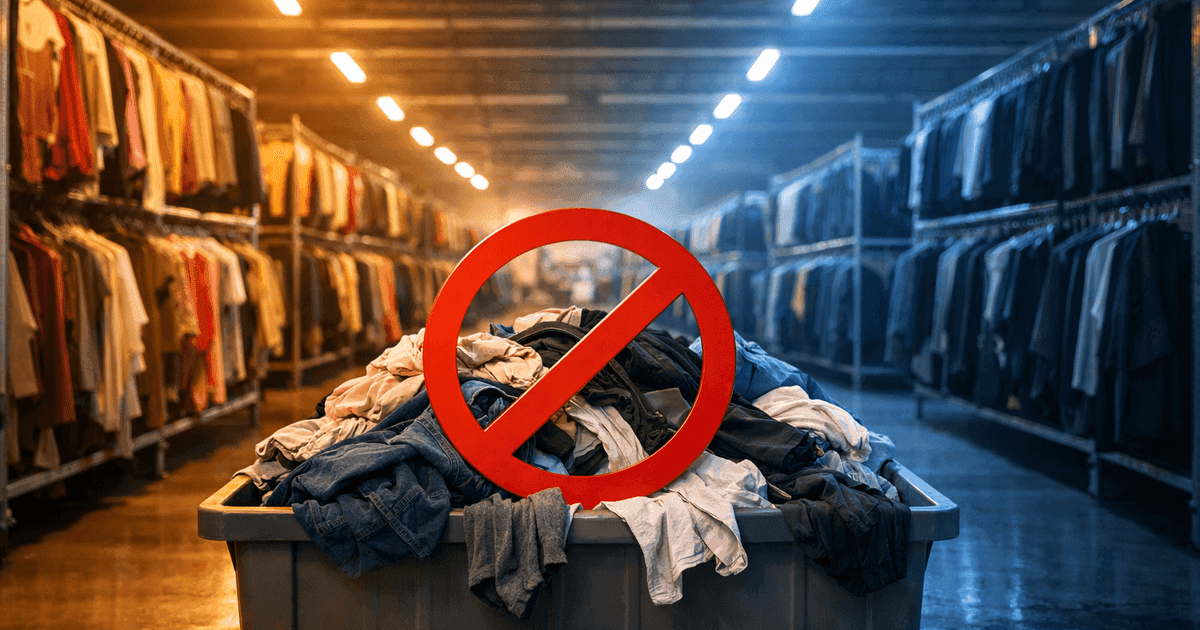
On February 9, 2026, the European Commission adopted new rules banning the destruction of unsold clothing, clothing accessories, and footwear under the ESPR (Ecodesign for Sustainable Products Regulation). Large enterprises have had to stop destroying unsold products since July 19, 2026. Small and micro enterprises are exempt from the ban itself, but not from the broader ESPR framework. These rules are separate from the Digital Product Passport requirements, but they signal how the EU intends to enforce sustainability compliance across the fashion industry.
What Did the EU Actually Adopt?
The Commission adopted two measures under ESPR Articles 24 and 25 of Regulation (EU) 2024/1781:
1. A delegated regulation specifying the limited circumstances where destruction of unsold products is still permitted:
- Products with verified safety defects that cannot be remedied
- Products with irreparable damage (e.g., fire, flood, contamination)
- Products that have exceeded a regulatory shelf life (rare for textiles, more relevant for cosmetics)
2. An implementing act standardizing how companies must report the volume of unsold products they destroy. This defines the exact format for the annual disclosure that ESPR Article 24 already requires.
The European Commission's press release confirms these measures cover clothing, clothing accessories, and footwear specifically.
Who Must Comply — And When
| Company Size | Destruction Ban | Disclosure Requirement |
|---|---|---|
| Large enterprises (250+ employees or 50M+ EUR turnover) | July 19, 2026 | Already in force: the first report covers the first full financial year the ESPR was in force (ESPR Article 24(1)) |
| Medium enterprises (50-249 employees) | July 19, 2030 | From July 19, 2030 (ESPR Article 24(1)) |
| Small enterprises (10-49 employees) | Exempt | Not required |
| Micro enterprises (fewer than 10 employees) | Exempt | Not required |
Small and micro enterprises are exempt from the destruction ban — but critically, they are not exempt from any other ESPR requirement, including Digital Product Passport obligations when those take effect. This is the only SME-specific carve-out in the entire ESPR framework. And companies near the size threshold should verify their classification carefully: if you cross the 50-employee or 10M EUR turnover threshold, you fall under the medium enterprise rules.
Why Does This Matter for Small Fashion Brands?
If you run a small brand with fewer than 50 employees, you might think this does not affect you. The direct ban does not — but the indirect effects will.
1. Supply Chain Pressure from Retailers
Large retailers who buy your products are covered by the ban. If they cannot destroy unsold inventory, they will push that risk back down the supply chain:
- Stricter buy-back and return clauses in wholesale agreements
- Tighter order quantities to reduce overproduction risk
- Increased pressure for sell-through data and demand forecasting
- Preference for brands that can demonstrate responsible inventory management
If your brand sells through department stores, multi-brand retailers, or wholesale channels, expect contract negotiations to change.
2. Marketplace Implications
EU marketplaces face scrutiny under both the ESPR and the Digital Services Act. Expect platforms like Amazon, Zalando, and ASOS to:
- Implement their own unsold product policies ahead of regulatory deadlines
- Require sellers to document what happens to returned or unsold inventory
- Potentially factor destruction-ban compliance into seller ratings or visibility
3. The Disclosure Reporting Template
The standardized reporting format means destruction data will be comparable across companies. This creates:
- Industry benchmarking — journalists and NGOs will rank companies by destruction volumes
- Investor scrutiny — ESG-focused investors will use this data
- Consumer awareness — advocacy campaigns will spotlight the worst offenders
Even if your brand is too small to report, you operate in an industry where this data will shape public expectations about what "responsible fashion" means.
The EU's stated goal is not just to prevent waste but to reduce overproduction. The Commission explicitly frames the destruction ban as an incentive for better demand forecasting, smaller production runs, and circular business models (resale, donation, recycling). This aligns with the broader direction of the ESPR — and with the data collection requirements that Digital Product Passports will eventually mandate.
What Counts as "Destruction" Under the Ban?
The regulation targets the intentional destruction of unsold consumer products. This includes:
- Sending unsold stock to landfill or incineration
- Shredding or compacting products to render them unusable
- Any process that permanently removes products from potential use
It does not prohibit:
- Selling unsold inventory at a discount
- Donating unsold products to charitable organizations
- Recycling unsold products through certified textile recycling
- Storing unsold inventory for future sale
- Using unsold products as raw materials for new production
The narrow exemptions (safety defects, irreparable damage) require documentation. Companies cannot simply declare products "damaged" to avoid the ban — market surveillance authorities can audit exemption claims.
The Disclosure Obligation
Large enterprises must disclose destruction data every year under ESPR Article 24(1) of Regulation (EU) 2024/1781, starting with the first full financial year the Regulation was in force. Medium enterprises follow from July 19, 2030. The February 2026 implementing act standardizes the reporting format. Companies must publish annually on their website:
| Data Point | Description |
|---|---|
| Product count | Number of unsold products destroyed in the reporting period |
| Total weight | Combined weight of destroyed products (kilograms) |
| Reasons | Justification for each destruction event (safety, damage, etc.) |
| Waste operations | Which waste treatment methods were used (landfill, incineration, recycling) |
| Prevention measures | What the company is doing to reduce future destruction |
The standardized format (Reg (EU) 2026/2) applies from March 2, 2027, starting with the first full financial year after that date. Each report is due within 12 months of the end of the financial year it covers.
How Does the Destruction Ban Connect to Digital Product Passports?
The destruction ban and DPP requirements are separate instruments, but they share infrastructure and logic:
Shared enforcement: Market surveillance authorities enforcing the destruction ban are the same authorities that will enforce DPP compliance. The reporting mechanisms being built now — standardized disclosure, EU registry, customs checks — lay groundwork for DPP enforcement.
Data overlap: The destruction ban requires companies to track product volumes, waste operations, and prevention measures. DPP requirements will demand far more detailed product-level data. Brands that build data collection processes now for destruction ban compliance are partially preparing for DPP compliance.
Overproduction reduction: The ban incentivizes smaller production runs and better demand forecasting. The DPP will provide the per-product data that makes this possible at scale — material composition, supply chain origin, and environmental footprint data that inform smarter production decisions.
For a deeper look at the full DPP compliance timeline, see our ESPR timeline guide. To understand what data you will eventually need to collect, see our DPP data requirements breakdown.
What Should Brands Do Now?
If You Are a Large Enterprise (250+ employees)
The ban has applied since July 19, 2026:
- Audit your current destruction practices — quantify how much unsold inventory you destroy and why
- Establish alternative channels — discount sales, donation partnerships, certified textile recycling
- Prepare your disclosure report — the standardized format is now defined; set up internal reporting
- Document exemptions carefully — any products destroyed after July 19 must fall within the narrow safety/damage exemptions with supporting evidence
- Train procurement and inventory teams — overproduction prevention is now a compliance issue, not just a cost issue
If You Are a Medium Enterprise (50-249 employees)
You have until July 19, 2030 for both the ban and the disclosure obligation:
- Start tracking destruction data now — you will need this for reporting
- Review overproduction patterns — use the lead time to reduce reliance on destruction
- Watch how large enterprises adapt — their approaches will become industry standard
If You Are a Small Brand (Fewer Than 50 Employees)
You are exempt from the ban, but you should:
- Understand the market context — your retail partners and marketplace platforms are not exempt
- Expect contract changes — wholesale agreements will evolve as buyers manage their own destruction ban compliance
- Start thinking about DPP readiness — the destruction ban is just the first ESPR enforcement milestone; DPP requirements for textiles follow in 2028-2029
If the destruction ban timeline feels sudden — an EU regulation adopted in July 2024 creating compliance obligations by July 2026 — that's the same timeline compression you can expect for textile DPP requirements. The delegated act is expected around the end of 2027, with requirements applying roughly 18 months later. Start collecting product data and mapping your supply chain now while the pressure is indirect, not mandatory.
The Bigger Picture: ESPR Enforcement Is Accelerating
The destruction ban is the first ESPR provision to create hard compliance deadlines for the fashion industry. It will not be the last:
| Milestone | Date | What Happens |
|---|---|---|
| Destruction ban (large enterprises) | July 19, 2026 | No more destroying unsold clothing/footwear |
| EU DPP Registry live | July 20, 2026 | Infrastructure for product passport enforcement goes live |
| Right to Repair transposition | July 31, 2026 | EU member states must implement repair obligations in national law |
| Battery Passport mandatory | February 18, 2027 | First real-world DPP under Regulation (EU) 2023/1542 — proof of concept for all sectors |
| Textile DPP delegated act | Late 2027 (expected) | Exact data fields and requirements for fashion brands defined |
| Textile DPP requirements apply | ~Late 2028/2029 | Compliance deadline for textile product passports |
Each milestone builds on the last. The destruction ban establishes enforcement infrastructure. The battery passport proves DPPs work in practice. The textile delegated act defines what fashion brands must do. And the compliance deadline makes it mandatory.
For the full timeline across all product categories, see our ESPR timeline guide.
Frequently Asked Questions
Does the destruction ban apply to shoes?
Yes. The February 9, 2026 implementing rules explicitly cover clothing, clothing accessories, and footwear. The same timeline applies: large enterprises from July 19, 2026, medium enterprises from July 19, 2030, small and micro enterprises exempt.
Can I still destroy defective products?
Yes, but only under narrow, documented exemptions. Products with verified safety defects that cannot be remedied, products with irreparable physical damage (fire, flood, contamination), and products that have exceeded a regulatory shelf life can still be destroyed. You must document the justification and maintain records for audit purposes.
What happens if I destroy unsold products after the deadline?
Market surveillance authorities can investigate and enforce. Penalties are set by each EU member state under the ESPR enforcement framework (which requires penalties to be "effective, proportionate and dissuasive"). See our DPP penalties guide for how ESPR enforcement works.
Does the ban apply to products manufactured before July 2026?
The ban applies to the act of destruction, not the date of manufacture. If you have unsold inventory manufactured before July 2026 and destroy it after the deadline, the ban applies. The solution: sell it at a discount, donate it, or recycle it through certified channels.
Is the destruction ban related to Digital Product Passports?
They are separate instruments under the same regulation — ESPR, Regulation (EU) 2024/1781. The destruction ban is enforced through Article 25, while DPP requirements come through product-specific delegated acts under Articles 8-9. However, they share enforcement infrastructure and the same market surveillance authorities enforce both. The destruction ban is the first ESPR compliance deadline for fashion; DPP requirements follow.
About the author