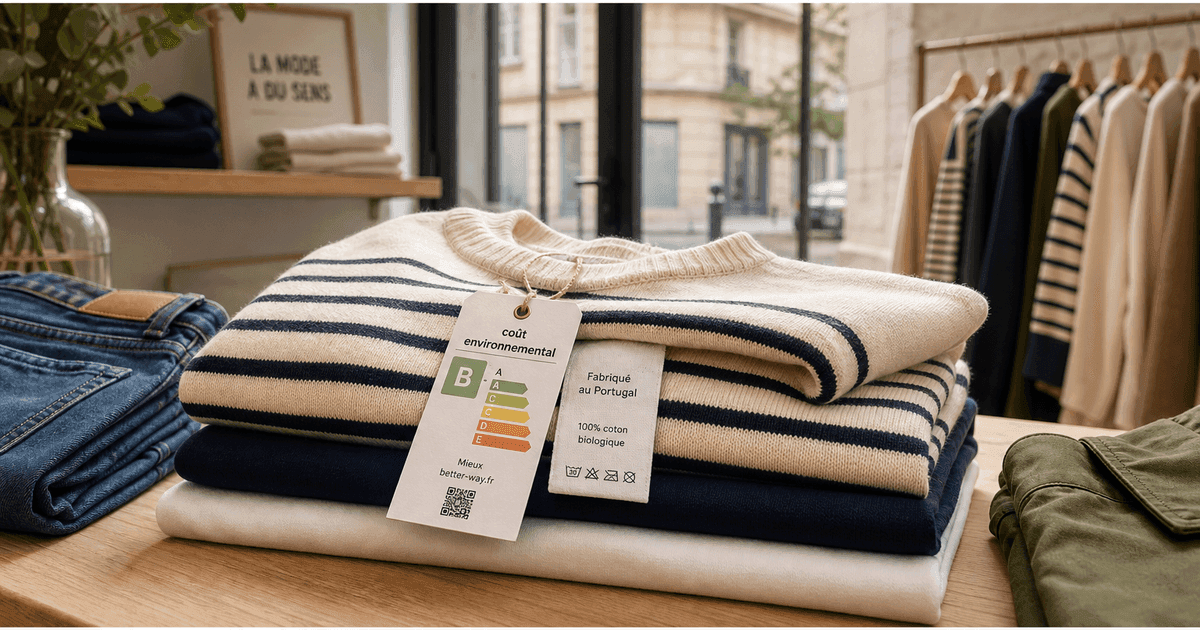
Brands selling textiles into France must comply with three national rules beyond the EU baseline: a ban on PFAS "forever chemicals" in clothing and footwear (in force since January 1, 2026), mandatory textile EPR via the Refashion scheme, and the coût environnemental environmental-cost label. All three apply to importers and foreign sellers — not just French companies.
France's textile rules at a glance
| Rule | Status | Who's caught | Key date | What to do |
|---|---|---|---|---|
| PFAS ban | In force | Anyone placing clothing/footwear on the French market | January 1, 2026 (all textiles 2030) | Get PFAS present/absent declarations from suppliers |
| Textile EPR (Refashion) | Live since 2007 | All producers, importers, sellers | Already mandatory | Register with Refashion; apply the Triman + Refashion mark |
| Coût environnemental | Voluntary to compute | Producers/importers/distributors of apparel | Self-publish since Oct 2025; third-party publication Oct 1, 2026 | Run your own score before a third party does |
| AGEC supply-chain disclosure | In force | Anyone placing textiles on the French market | Already mandatory | Disclose country of weaving/knitting, dyeing/printing, confection |
What is France's PFAS ban on textiles?
France's PFAS law (Loi 2025-188 of 27 February 2025) and its implementing decree (Décret 2025-1376 of 28 December 2025) ban the manufacture, import, and sale of clothing, footwear, and water-repellent treatments that contain PFAS — the "forever chemicals" used for stain, water, and grease resistance. The ban has been in force since January 1, 2026.
PFAS — per- and polyfluoroalkyl substances — are a large family of synthetic chemicals prized in apparel for repelling water, oil, and stains. They are also persistent in the environment and the human body, which is why regulators increasingly target them. France's ban reaches the finished product and the treatment applied to it: a durable water-repellent (DWR) coating on a jacket is squarely in scope, not just garments where PFAS appears in the base fabric.
There are two carve-outs. A 12-month stock-depletion window applies to products manufactured before January 1, 2026, so existing inventory can be sold through during 2026. Protective clothing for the military and for firefighters is exempt, reflecting the lack of viable PFAS-free alternatives for those uses today. The ban then widens significantly: from January 1, 2030 it covers all textiles, including home and furnishing textiles such as upholstery, curtains, and bed linen.
France isn't moving alone here. The EU is working on a universal PFAS restriction under REACH, with an opinion from ECHA's scientific committee (SEAC) expected around the end of 2026. That restriction isn't adopted yet, and its scope and timing are still open. Either way, getting France-compliant on PFAS now puts you ahead of what the EU is likely to require next, rather than down a one-country dead end.
Enforcement sits with the DGCCRF, France's consumer protection and competition authority. Non-compliant products can be pulled from the market, and fines apply under national law.
A PFAS present/absent declaration is also a strong candidate field for a textile Digital Product Passport, so capturing it once from your suppliers serves both the French ban and your DPP data set.
Does the PFAS ban apply to imported clothing?
Yes. Because the ban covers manufacture, import, and sale, an importer or foreign e-commerce seller that places PFAS-containing clothing or footwear on the French market is caught exactly like a French manufacturer. There is no carve-out for products made abroad. The obligation attaches to the act of selling into France.
Foreign sellers and importers are caught. If you import into France or ship directly to French customers from outside the country, the PFAS ban applies to you. The trigger is placing the product on the French market, not where your company is based or where the garment was made. Marketplaces and direct e-commerce are both in scope.
How does textile EPR work in France?
France has run mandatory textile Extended Producer Responsibility through the Refashion scheme since 2007. Anyone selling textiles into France — French or foreign, large or small — must register with Refashion and pay end-of-life fees. This is live today, years ahead of the EU-wide rollout (roughly April 2028) under the revised Waste Framework Directive. France also requires the Triman logo plus the Refashion sorting-instruction mark on products, telling consumers how to dispose of them. For producer definitions, eco-modulation mechanics, fee levels, and the EU 2028 timeline, see our full EU textile EPR breakdown.
What is the coût environnemental (environmental-cost label)?
The coût environnemental is France's life-cycle-assessment (LCA) based "environmental-cost" score for apparel, established by Décret 2025-957 of 6 September 2025. Brands have been able to self-publish their score since October 1, 2025. The score is computed using Ecobalyse, the French government's official calculator — note that Ecobalyse is the tool, not the name of the label, so the score itself should never be called "Ecobalyse."
The scope is specific: 11 categories of apparel (clothing). It excludes footwear, accessories, leather goods, and items that are more than 20% non-textile by mass. So a heavily embellished or hardware-laden piece can fall outside the eco-score while still facing the PFAS ban, EPR, and AGEC disclosure. Within scope, it applies to all producers, importers, and distributors placing textile clothing on the French market, regardless of origin or company size. Enforcement again sits with the DGCCRF.
The score comes out as a single environmental-cost figure, calculated from a full life-cycle assessment of the garment. It's built from real product attributes, not a self-declared rating, so your number is only as good as the data behind it. That's the reason to run it yourself instead of leaving it to default assumptions.
To prepare, run your own score through the Ecobalyse tool before a third party does, and gather the LCA inputs it needs: material composition, product mass, country of origin, and finishing treatments. This score draws on the same LCA, material, and supply-chain data backbone as a Digital Product Passport, so the data you collect for a DPP feeds the calculation directly. Not every DPP platform can also file that score, so it is worth checking before you commit — we compared nine of them on price, data export and coût environnemental support.
Is the environmental-cost score mandatory?
It depends, and this is the part brands most often get wrong. The score is voluntary to compute: there is no blanket obligation to calculate and display it. Two things change that for individual brands. First, from October 1, 2026, any third party (an NGO, a journalist, a competitor, or a marketplace) may calculate and publish a garment's score from available or estimated data — and the methodology's fallback values are deliberately penalizing (an unknown origin counts as India, for example). The brand always keeps the upper hand, though: once it deposits its own score on the official portal, its figure legally prevails, and the third party must align with it within one month (Article D. 541-244 of the Environmental Code). Second, display becomes mandatory only for a brand that itself communicates a score for one or more environmental impacts of the product — a carbon-footprint figure, say (Article D. 541-245). The trigger is a published number, not wording: a purely verbal claim such as "organic cotton" or "eco-responsible" does not, on the letter of the decree, force the display. Verbal claims fall instead under misleading-practices law and the EU's green-claims rules, which the DGCCRF enforces actively — its 2026 investigation campaign explicitly targets environmental claims on textiles. In practice: publish environmental figures and the coût environnemental becomes required alongside them; make word-only claims and you must be able to prove them — and you still want to know your score before a third party publishes one for you.
Run your score before someone else does. Even though computing the score is voluntary, the October 1, 2026 third-party publication right means a brand that does nothing can still have a penalizing default-data score published about it. You can answer at any time — once your own score is deposited on the official portal it legally prevails, and the third party must align within one month — but it is far better to publish your number before someone else's version of it circulates.
Who must comply when selling textiles into France?
All three rules — plus AGEC — are market-based and origin-agnostic. The trigger is placing a product on the French market, not where the company sits or where the goods were made. Importers, online marketplaces, and foreign e-commerce sellers shipping directly to French customers are all caught. Company size creates no exemption: a small foreign brand selling a handful of garments into France carries the same obligations as a large French manufacturer.
How France's textile rules fit together
France stacks national textile rules on top of the EU's DPP and ESPR baseline, and it tends to move ahead of the rest of the bloc. That makes it a useful preview of where EU textile rules are heading. The common thread running through all of it is product data.
A fourth French rule makes this concrete. France's AGEC law (Décret 2022-748) already requires disclosing where a textile was woven or knitted, where it was dyed or printed, and where it was assembled (confection). That is about as close as a live national rule gets to Digital Product Passport traceability data. The PFAS ban points the same way: get ahead of it, and you also front-run the EU REACH restriction still to come. Taken together, these rules favor brands that treat product data as infrastructure rather than paperwork — collect it once, keep it structured, reuse it. That is the same logic behind a Digital Product Passport for fashion brands.
Frequently Asked Questions
Does the France PFAS ban apply to imported clothing?
Yes. France's PFAS ban (Loi 2025-188 and Décret 2025-1376) prohibits the manufacture, import, and sale of PFAS-containing clothing and footwear placed on the French market since January 1, 2026. Because it covers import and sale, foreign manufacturers, importers, and e-commerce sellers shipping into France are caught the same as French companies. The trigger is selling into France, not where the product was made.
What is the coût environnemental environmental-cost label?
The coût environnemental is France's life-cycle-assessment-based environmental-cost score for apparel, established by Décret 2025-957. Brands compute it with Ecobalyse, the French government's official calculator — Ecobalyse is the tool, not the label. It scores a garment on its environmental impact using inputs like materials, mass, country of origin, and treatments, and applies to clothing placed on the French market.
Is the environmental-cost score mandatory in France?
Not as a blanket rule. The score is voluntary to compute. However, from October 1, 2026, any third party can calculate and publish a garment's score using penalizing default data; the brand can neutralize this at any time by depositing its own score on the official portal, which then legally prevails (the third party must align within one month). Separately, display becomes mandatory only for brands that themselves communicate an environmental score for the product, such as a carbon-footprint figure — a purely verbal claim without a number does not trigger the display duty, though it must still comply with anti-greenwashing rules.
Does France's environmental-cost label cover footwear?
No. The coût environnemental covers 11 categories of apparel (clothing) only. Footwear, accessories, leather goods, and items that are more than 20% non-textile by mass are excluded from its scope. Other French rules — the PFAS ban, textile EPR, and AGEC disclosure — apply more broadly, including to footwear, so a product outside the eco-score scope can still face the other three.
Do I need a Digital Product Passport to comply with French textile rules?
No. France's PFAS ban, textile EPR, eco-score, and AGEC disclosure are separate national rules with their own legal bases, and a Digital Product Passport is not legally required to satisfy them. But the same product data — material composition, supply-chain origins, and LCA inputs — answers all of them. Capturing that data once for a DPP also serves France's rules, so the two reinforce each other.
France's textile rules all run on the same product data. PassportCraft helps brands collect that material, supply-chain, and LCA data once and reuse it across compliance obligations. See how a Digital Product Passport for fashion brands fits in.
This article is general information, not legal advice. Verify current obligations against the relevant French decrees and laws and consult a qualified advisor before relying on it for compliance decisions.
About the author