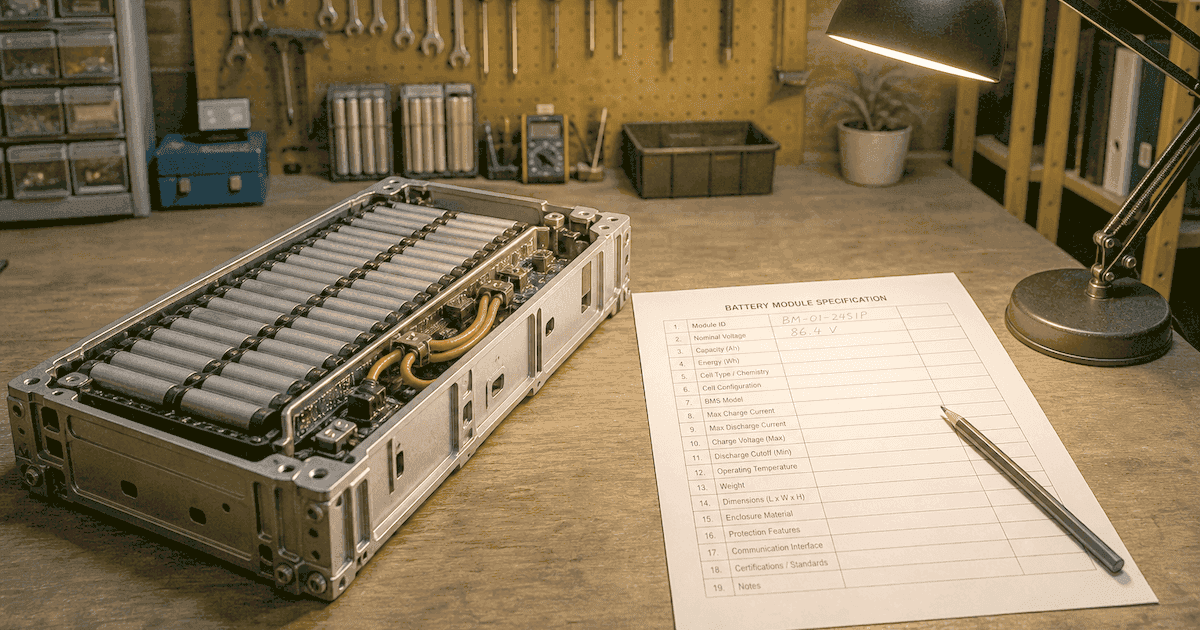
We signed in to four of these tools and tried to build a battery passport in each. The distance between them is enormous: one asks for thirty-seven of the values the law names, another asks for none.
From 18 February 2027, every LMT battery — the regulation's term for a light means of transport, such as an e-bike or a scooter — every industrial battery above 2 kWh and every electric vehicle battery placed on the EU market must carry a battery passport.
What goes in it is not a matter of interpretation. If you are new to the obligation itself, our EU battery passport guide covers who it applies to and when. This article is about something narrower: whether the software you are choosing can actually hold the data. The EU Batteries Regulation lists the contents item by item, in an annex to the law — Annex XIII — and Article 77 of the same regulation says who is allowed to read each part.
That matters when you are choosing a tool. Batteries are the only product category whose contents are already set out this precisely in adopted law, with a date attached — so a tool either has a field for each item or it does not, and you can check which before you commit.
Your deadline, and who is allowed to see what you enter
Two things are set out in law. The second one is the one that catches people out.
When it applies to you. From 18 February 2027, every LMT battery, every industrial battery above 2 kWh and every electric vehicle battery you place on the EU market needs a passport. The 2 kWh threshold applies to industrial batteries only — an LMT or EV battery needs one whatever its size.
Who reads which part. The passport is not one page for everybody. The law splits it four ways:
| Annex XIII | Contains | Who can read it |
|---|---|---|
| Point 1 | Nineteen items: general information, composition, carbon footprint, sourcing, recycled content, electrical characteristics, lifetime, marking, declaration of conformity, waste handling | The general public |
| Point 2 | Detailed cathode/anode/electrolyte composition, part numbers and spare-part sources, dismantling information, safety measures | Persons with a legitimate interest and the Commission; Article 77(2)(b) also names notified bodies and market surveillance authorities, and the two readings are not settled |
| Point 3 | Test reports proving compliance | Notified bodies, market surveillance authorities and the Commission |
| Point 4 | Performance and durability values, state of health, status (original, repurposed, re-used, remanufactured, waste), usage data | Persons with a legitimate interest |
Two things follow, and both decide which software you can live with.
The first nineteen items are public. They land on the page a customer reaches by scanning the code on your battery. If your tool has no box for one of them, that item is not sitting in a database waiting — it is missing from the page a regulator can open.
The rest is not public, and a tool that cannot tell the difference will publish it anyway. Your detailed cell chemistry and your part numbers going onto the open web is not a compliance failure. It is worse in a way compliance does not cover: you cannot take it back.
The list is not the same as the launch checklist. Annex XIII says what a battery passport contains. It does not say what has to be filled in on the first day. In August 2026 the Commission's guidance drew that line: the carbon footprint and all four recycled-content shares are marked not to be filled or displayed as of February 2027, because each waits on an act that does not exist yet, and responsible sourcing is marked the same way for a different reason — Article 48(1) simply does not start battery due diligence until 18 August 2027. That does not change the test below — a tool with no box for an item cannot hold it later either — but if you are deciding what to collect first, see what a battery passport actually needs on day one.
An honest gap, worth knowing before a vendor tells you otherwise: the Commission has still to spell out who counts as a person with a legitimate interest and exactly what they may reach. Until it does, nobody — including us — can tell you precisely where that line falls.
What the tools actually ask for
Seven tools were looked at. Five appear below, against the nineteen items in the public part of the list, plus one row on whether the tool separates the audiences at all. We got inside four of them.
How to read this table
Where we could get in, we started creating a battery passport and read the form the tool put in front of us. That is the test: not what a vendor's website lists, but what the software asks a brand to type. The method note at the foot says which column came from where.
The rows group the law's items the way the law does, so one row can carry more than one item, and a row marked Partial can still hold an item with no box at all.
- Asked — the form has a box for the value the rule names, and names it.
- Partial — the form asks for part of it: one box where the rule separates several values, or a box for something adjacent rather than the thing named.
- Absent — nothing the product ships asks for it.
- Unknown — we could not get into the product to look.
We score on whether the form asks for the value and names it, not on whether it checks what you type. Most of these boxes are free text in every tool here, ours included.
The last row is not one of the nineteen items. It asks whether the tool separates the audiences at all: Asked means it does, Absent means everything a brand enters is world-readable, and Unknown means we could not see either way.
| Annex XIII item | PassportCraft † | DPP-Tool | ProductPasses | MyProductPassport | OriginPass |
|---|---|---|---|---|---|
| 1(a) General information | Asked | Partial | Partial | Partial | Unknown |
| 1(b) Composition, hazardous substances, critical raw materials | Asked | Partial | Partial | Asked | Unknown |
| 1(c) Carbon footprint | Asked | Partial | Absent | Asked | Unknown |
| 1(d) Responsible sourcing | Asked | Partial | Partial | Asked | Unknown |
| 1(e) Recycled content | Asked | Partial | Absent | Asked | Unknown |
| 1(f) Share of renewable content | Asked | Absent | Absent | Asked | Unknown |
| 1(g)(h)(i) Capacity, voltages, power | Asked | Absent | Partial | Partial | Unknown |
| 1(j)(k)(p) Lifetime, exhaustion threshold, c-rate | Asked | Partial | Partial | Partial | Unknown |
| 1(l)(m) Temperature range, warranty | Asked | Partial | Absent | Asked | Unknown |
| 1(n)(o) Round-trip efficiency, internal resistance | Asked | Absent | Absent | Partial | Unknown |
| 1(q) Marking requirements | Asked | Absent | Absent | Asked | Unknown |
| 1(r) EU declaration of conformity | Asked | Partial | Partial | Partial | Unknown |
| 1(s) Waste battery information | Asked | Absent | Partial | Asked | Unknown |
| Access tiering implemented | Asked | Absent | Absent | Absent | Unknown |
OriginPass has not launched. Its site plans a first version for Q4 2026 and its sign-up asks for an access code, so we could not get in and neither can you. It does publish a price list and demo passports. It is in the table because brands are being pitched it now, not because there was anything to open.
† PassportCraft is our own product. We read its form the same way we read the others, but we also wrote it — so treat our column as the one to check hardest, not the one that settles the table.
Correction, 15 September 2026: PassportCraft’s 1(s) cell. We changed this rating from Partial to Asked after checking that our form asks for all six Article 74(1) items, including waste-battery safety instructions. The missing safety-instructions field was the public-list gap described below. This cell is an exception to the 28 August snapshot below; the other cells and competitor ratings have not been rechecked.
Two things the table is not saying.
Absent does not mean non-compliant. This table assesses fields for the battery-passport requirement from 18 February 2027. A missing named field alone does not establish non-compliance. Other battery obligations already apply.
A form is not the whole product. Fields can also arrive through an import file or an API, and a vendor can add a battery template tomorrow. Every cell here describes what the software offered on 28 August 2026, except OriginPass, which we could not open.
What three of the tools put in front of us
DPP-Tool: the sector is a required choice that changes nothing
DPP-Tool's form makes you pick a sector. It is one of three boxes you cannot skip, and "batteries" is on the list.
Choose it and the form does not change. Not one box is added. We counted before and after: the same fifty-seven controls, with the same names.
What you get is the form every product gets — name, manufacturer, GTIN, model, batch number, country, carbon footprint, recycled content, energy class, expected lifetime, warranty years, repairability score, recyclability, origin country, certificates, material composition, and a handful more for spare parts, hazardous substances and due diligence.
There is no box for the chemistry, the capacity, the voltage, the power, the temperature range, the efficiency, the internal resistance or the charge rate. None for the EU declaration of conformity, only a general list of certificates to tick. None for the extinguishing agent — what a firefighter needs before opening a burning battery — even though the law puts that on the public page. And none for state of health, which the law shows to a smaller group of readers.
So a brand can fill in every box this tool offers and still not have a battery passport. Three boxes start one: a name, a manufacturer, and the sector that does nothing.
MyProductPassport: thirty-seven boxes, and it will not let you publish half a passport
The opposite case, and worth seeing because it shows what asking properly looks like.
Create a product, generate its passport, and the page reads "0 of 37 required fields completed for Batteries". Below it sit thirty-seven boxes, several naming the unit the rule uses — rated capacity in ampere-hours, power capability in watts, internal resistance in milliohms, capacity fade as a percentage at 80% of lifecycle. Recycled cobalt, lead, lithium and nickel each get their own box, and the cobalt one carries its 2031 minimum. Several name the article of the regulation they come from.
Three things it still does not do. There is no box for round-trip efficiency, or for the charge rate. There is one box for voltage where the law names three — minimum, nominal and maximum — and none for the extinguishing agent, which the law puts on the public page. And everything sits in one flat form — including the dismantling instructions, the spare-part sources and the state of health, three things the law keeps off the public page. A tool that collects them beside the public fields has no way to hold them back.
It also refuses to publish until the passport is half filled in. That is the opposite of the failure worth worrying about.
ProductPasses: the whole battery story is one box
New products start by picking a template, and the templates are Minimal, Quick start, Accessories, Cosmetic, Electronics, Footwear, Furniture, Tableware, Textile and Toys. There is no battery one.
Templates decide which boxes a passport has, so the nearest thing a brand can start from is the electronics template. It has twelve fields, and exactly one of them is about the battery. Its label is "Battery info & charging guidance" and the hint underneath reads: capacity in milliamp-hours, chemistry, replaceable yes or no, charge cycles, energy class.
Five values the law separates, in one free-text box. Nowhere in the template is there a voltage, a power figure, a temperature range, an internal resistance, a carbon footprint, a recycled-content percentage or a marking. A brand who wants those builds them by hand in a blank template.
What this means if you are choosing a tool
Ask for a battery passport the vendor has published, not a screenshot. If they cannot show you one, that is your answer. Most of these tools also went through a wider test — price, free tier, data export and GS1 addressing — in our comparison of Digital Product Passport software, which covers nine platforms rather than seven.
Count the fields against the nineteen items yourself. It takes ten minutes and it is the only test in this category a legal text can settle. If you are working out what to gather in the first place, we have a longer piece on what data a passport actually needs.
Ask what happens when a required field is empty. One tool here refuses to publish until the passport is half filled in. Another asks for three boxes before it will start one. We did not test what any of them does at the moment you press publish, and neither will you unless you ask.
Ask whether it separates the audiences. If everything you enter goes to one public page, you will publish things the law never asked you to publish, and you will not get them back.
PassportCraft is battery passport software for the EU market.
Frequently Asked Questions
What information must a battery passport contain?
The EU Batteries Regulation sets it out in four parts, in Annex XIII. The first part is nineteen publicly readable items covering general information, material composition including hazardous substances and critical raw materials, carbon footprint, responsible sourcing, recycled and renewable content, capacity and voltage and power, expected lifetime, temperature range and warranty, round-trip efficiency and internal resistance, marking requirements, the EU declaration of conformity, and waste-handling information. The remaining three parts add detailed composition, dismantling and safety information, test reports, and performance and state-of-health data, each on narrower access terms. Who reads point 2 is not settled: Annex XIII names persons with a legitimate interest and the Commission, while Article 77(2)(b) also gives it to notified bodies and market surveillance authorities.
Which batteries need a passport?
Three kinds: LMT batteries — the regulation's term for a light means of transport, such as an e-bike or a scooter — industrial batteries above 2 kWh, and electric vehicle batteries. The 2 kWh threshold applies to industrial batteries only, so an LMT or EV battery needs a passport whatever its size.
When does the EU battery passport become mandatory?
18 February 2027. From that date every LMT battery, every industrial battery with a capacity greater than 2 kWh, and every electric vehicle battery placed on the EU market or put into service must have one. The 2 kWh threshold applies to industrial batteries only.
Is all battery passport data public?
No, and this is the part most tools get wrong. The nineteen items in the first part of Annex XIII are readable by the general public. The second part names persons with a legitimate interest and the Commission, and Article 77(2)(b) also gives it to notified bodies and market surveillance authorities; that overlap is not settled, so the safer build serves both. The third goes to notified bodies, authorities and the Commission. The fourth goes to persons with a legitimate interest. A tool with one public page cannot express that, so anything you enter is published to everyone. You can see what a finished passport looks like in our Digital Product Passport examples.
Method, and who wrote this
Who published this. PassportCraft publishes this and sells a Digital Product Passport tool.
Each column rests on something different, and here is exactly what. DPP-Tool and MyProductPassport were read from the form a brand fills in. ProductPasses was read from its template library, because it ships no battery template and the form follows the template. OriginPass could not be opened at all. Ours was read from the schema our own form is generated from — the same fields a brand sees, but read from the source rather than by using the product, which is not the standard we held anyone else to. It is the one asymmetry in this article we cannot design away, so we are naming it rather than leaving ourselves out and letting the omission do the flattering.
We ran the same audit against ourselves and it found one gap in the public list, marked in the table. It also found two gaps in the restricted parts: no field for state of health and none for recorded usage data, both of which need per-unit measurements we do not currently collect. Those are on our roadmap rather than fixed.
What was checked. Regulation (EU) 2023/1542 was read in the consolidated text on EUR-Lex, version 02023R1542 dated 31 July 2025, which incorporates the amending regulations and corrigenda in force. Articles 3, 13, 74(1), 77 and 78, Annex VI Part A and Annex XIII were read in that file. Where a claim would have depended on an article we did not read in full, it is not in this article.
How each tool was checked, one by one. We signed up to four of these tools and used them on 28 August 2026. In DPP-Tool we opened the new-product form and set the sector to batteries. In MyProductPassport we created a product and generated its passport, which is where its battery fields appear. In ProductPasses we read the template library, because a template decides which boxes a passport has and no battery template ships. In DPPilot we opened the add-product form, which has no sector at all. OriginPass we could not open. Vendor pages, published passports and published API contracts were read on 26 August 2026 and inform the surrounding prose, not the table.
What was not checked. OriginPass has not launched and its sign-up needs an access code, so its column says only that we could not look. We did not test importing a spreadsheet or writing through an API in any tool, and a field reachable that way but absent from the form is not counted here. Two of the seven tools, DPPilot and Wetrack, were left out of the table because neither sells into the battery categories the rule covers — DPPilot's form has no sector at all, for any product.
If we got something wrong. If you work for one of these vendors and something here is inaccurate or unfair, write to hello@passportcraft.com. We will re-check it and correct the page, and that includes corrections that go against us. Corrections are dated where we make them.
About the author